
Category: Edgar Filings

Who Owns the 10-K Filing Timeline Internally?
Preparing a Form 10-K is not the responsibility of a single department. The process is commonly carried out through coordinated efforts between finance, legal, SEC reporting, management, auditors, investor relations, and filing support. Each team owns a different part of the process, so responsibility is naturally shared across the company. Does that mean there’s no […]
| 10/26/2026

How to Prepare Early for a 10-K Filing Deadline
The Form 10-K is one of the crucial filings that public companies must file with the SEC annually within prescribed deadlines, with consequences for a late filing. These consequences can include delinquency in SEC reporting, loss of timely filer status with the SEC, possible loss of Form S-3 eligibility, and more. This is why it […]
| 10/01/2026

Common 10-K Filing Deadline Mistakes—and How to Avoid Them
A company can prepare its annual report on time and still file late if it calculates the wrong deadline. The Form 10-K due date depends on filer status and fiscal year-end, and the final date may change when it falls on a weekend or federal holiday. EDGAR’s same-day filing cutoff adds another time to track. […]
| 09/29/2026

10-K vs. 20-F Deadlines: Key Differences for U.S. and Foreign Issuers
Form 10-K and Form 20-F are annual reports filed with the Securities and Exchange Commission (SEC), but they follow different filing schedules. The SEC Form 10-K is generally due 60, 75, or 90 calendar days after fiscal year-end, depending on filer status. The SEC Form 20-F annual report is generally due four calendar months after […]
| 09/14/2026

Form 8-K vs. Form 10-K: Filing Deadlines and Key Differences
Form 8-K reports specified corporate events, while Form 10-K provides an annual overview of a company’s business and financial results. Their filing deadlines follow different schedules: an 8-K generally follows a reportable event, and a 10-K follows the company’s fiscal year-end. For reporting teams, the distinction affects how deadlines are calculated, when documents need to […]
| 09/11/2026

10-K vs. 10-Q Filing Deadlines: SEC Due Dates and Extensions
The applicable deadlines for Form 10-K and Form 10-Q depend on a company’s filer status. Form 10-K is measured from fiscal year-end and generally has a longer filing window, while Form 10-Q is measured from the end of the applicable fiscal quarter. What Are the Form 10-K and Form 10-Q Filing Deadlines? The following table […]
| 09/04/2026

EDGAR Filing Cutoff Times: What Counts as On Time for an SEC Filing?
If a Form 10-K is due on March 31 and a company begins transmitting it through EDGAR after 5:30pm Eastern Time that day, will it count as an on-time filing? Generally, no. Although EDGAR operates from 6am to 10pm ET on business days, most live submissions must begin transmission at or before 5:30pm ET and […]
| 09/01/2026

NT 10-K Filing Deadline Explained: When and How the Extension Works
Missing a Form 10-K filing deadline does not necessarily mean a company is immediately out of compliance. Under Rule 12b-25, an eligible company that cannot complete its annual report on time may file Form 12b-25, commonly referred to as an NT 10-K. Doing so can provide an additional 15 calendar days to submit the Form […]
| 08/27/2026

How 10-K Deadlines Work for Non-Calendar Fiscal Year Ends
Not every public company ends its fiscal year on December 31. Some issuers use a March 31, June 30, September 30, January 31, or other fiscal year-end that better matches their business cycle. For these companies, the Form 10-K deadline is not tied to the calendar year. It is calculated from the company’s actual fiscal […]
| 07/08/2026

IPO Readiness: Are You Prepared?
Taking a company public is one of the most important decisions a business can make. It can open the door to new capital, greater visibility, and long-term growth, but it also brings a much higher level of regulatory responsibility, financial transparency, and public scrutiny. For many CEOs, founders, and finance teams, the IPO process can […]
| 06/30/2026

AI in Proxy Voting: Why EDGAR Filing Services and SEC Compliance Matter
For decades, proxy voting has been one of the most labor-intensive functions in institutional investing. Asset managers, pension funds, mutual funds, and other large institutional shareholders participate in thousands of shareholder votes each year, evaluating proposals that influence the future direction of public companies. These proposals can involve board elections, executive compensation, merger approvals, cybersecurity […]
| 06/30/2026

SEC Semiannual Reporting Proposal: What Public Companies Should Know About Form 10-S
The U.S. Securities and Exchange Commission’s SEC semiannual reporting proposal could significantly change how public companies meet their periodic reporting obligations. Under the proposal, public companies currently required to file quarterly reports on Form 10-Q would have the option to file a new semiannual report on Form 10-S instead. The SEC issued the proposal on […]
| 06/24/2026

SEC Climate Disclosure Rules Rescission: What Public Companies Need to Know
The U.S. Securities and Exchange Commission has proposed rescinding the SEC climate disclosure rules, a significant regulatory development that could reshape public company reporting, SEC compliance, and annual report disclosure obligations. On May 29, 2026, the SEC proposed rescinding its climate-related disclosure rules in their entirety. The proposal, published in the Federal Register on June […]
| 06/24/2026

SEC Registered Offering Reform: Proposed Changes to Public Company Reporting Requirements
On May 19, 2026, the U.S. Securities and Exchange Commission (SEC) proposed a sweeping SEC registered offering reform package and related changes to public company reporting requirements designed to modernize the public company reporting framework and improve access to capital markets. If adopted, these proposed amendments would represent the most significant overhaul of registered offering […]
| 06/24/2026

SEC HFIAA Exemptive Order Explained: EDGAR Filing Rules for Foreign Issuers (2026)
In February 2026, the U.S. Securities and Exchange Commission (SEC) introduced an exemptive order under the Holding Foreign Insiders Accountable Act (HFIAA), along with supporting technical guidance. While the update is relatively focused, it introduces meaningful changes for foreign private issuers (FPIs) and their leadership teams. Directors and executive officers of FPIs are now required […]
| 04/15/2026
SEC EDGAR Release 26.0.1: Key Updates, Form N-CR Changes, and What Filers Need to Know
On February 2, 2026, the U.S. Securities and Exchange Commission implemented EDGAR Release 26.0.1, introducing targeted updates across the EDGAR Filing Website, Online Forms Management Website, Filer Management Website, and related APIs. While this SEC EDGAR update is not a major system overhaul, it includes important refinements to submission notifications and changes to certain filing […]
| 04/14/2026

Section 16 Filings Now Required for Foreign Private Issuers
Beginning March 18, 2026, directors and officers of foreign private issuers will face a reporting obligation that many have never dealt with before. A change in U.S. securities law now brings these insiders squarely into the Section 16(a) reporting regime, a framework that has historically applied only to domestic public companies. The shift is the […]
| 01/20/2026

A Complete Guide to SEC Form S-3
For public companies looking to raise capital quickly and efficiently, Form S-3 can be a powerful tool. It enables eligible issuers to file a short-form registration statement, leveraging previously filed reports to reduce redundancy and streamline the path to market. Whether you’re planning a follow-on offering, enabling resales, or building a shelf for future flexibility, […]
| 12/22/2025

How to Enroll in EDGAR Next for Existing SEC Filers
Now is the time to enroll in EDGAR Next! The SEC’s new EDGAR platform, EDGAR Next is now live. All current/existing SEC filers must enroll in the new system prior to September 12, 2025. If you don’t enroll during the enrollment window, you will need to reapply for EDGAR access with a signed and notarized […]
| 06/06/2025

How to Revise a Reg D Filing with the SEC
Revising a Regulation D filing with the Securities and Exchange Commission (SEC) maintains compliance with securities regulations and ensures the integrity of a private placement. Changes in the offering details, corrections of prior errors, or regulatory updates often necessitate such revisions. Effective amendments safeguard against potential legal issues and position the business for continued success. […]
| 11/07/2024

SEC Makes Changes to EDGAR System: Security, Filer Access, Account Management
The U.S. Securities and Exchange Commission (SEC) recently announced significant updates to the Electronic Data Gathering, Analysis, and Retrieval (EDGAR) system. These changes are designed to enhance the system’s security and improve filers’ access to and management of their accounts. What Businesses Need To Know About EDGAR System Enhancements The latest enhancements to the EDGAR […]
| 10/22/2024

What SEC EDGAR Filings Do I Need for a Reg D Offering?
In the world of securities and investments, compliance with regulatory bodies is paramount. Ensuring that the right filings are made to the Securities and Exchange Commission (SEC) can be the difference between a smooth fundraising process and a legal quagmire. When planning a Regulation D (Reg D) offering, one of the most commonly asked questions […]
| 08/28/2023
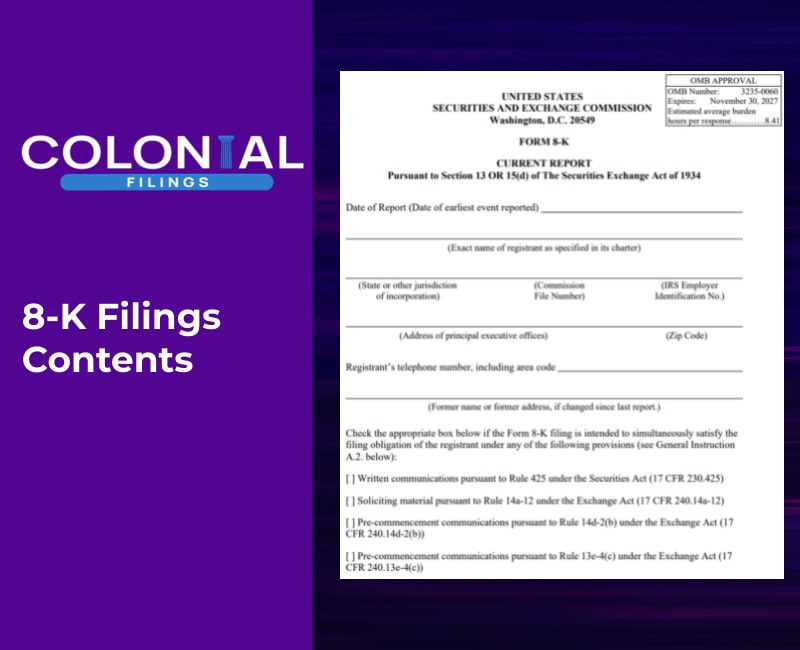
What Is Included in 8-K Filings?
When it comes to corporate governance and compliance, Form 8-K is a crucial document that companies must submit to the Securities and Exchange Commission (SEC) in the United States. Form 8-K gives investors a clearer picture of important events happening within a company. This form helps ensure transparency when it comes to reporting material events […]
| 08/10/2023

What Is an SEC Filing Agent and Do I Need One?
Managing regulatory filings for a public company is a task requiring meticulous attention to detail, understanding of regulatory requirements, and timely execution. It involves keeping track of numerous deadlines, forms, and changes in SEC regulations. This is where an SEC filing agent comes in. SEC filing agents are professionals who specialize in assisting public companies […]
| 08/08/2023