
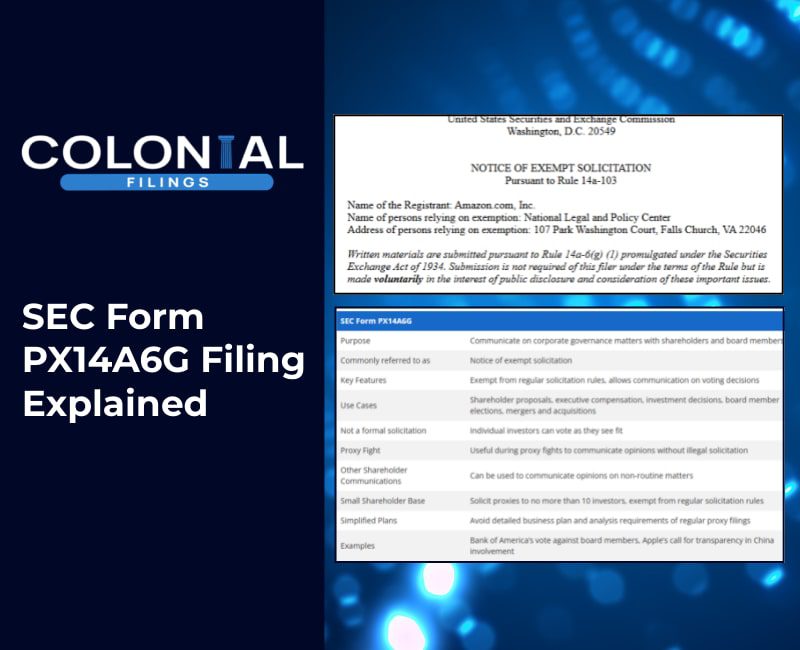
As an investor or business owner, it’s important to do your due diligence and understand what documents you need to file with the Securities and Exchange Commission (SEC). One such document is SEC Form PX14A6G. This form is used to communicate with other shareholders and board members about matters related to corporate governance. The purpose of the form is to give shareholders a voice in corporate decision-making, providing them with the opportunity to express their views on issues such as executive compensation, future decisions on shares, board member elections, and proxy fights among others.
How SEC Form PX14A6G Helps
SEC Form PX14A6G makes it possible for investors to be exempt from regular solicitation rules if they want to oppose a shareholder proposal and inform other shareholders about their voting decisions. This is why you’ll also hear this form commonly referred to as a notice of exempt solicitation.
Instead of an investor following traditional solicitor rules, they can instead file SEC Form PX14A6G with the SEC in accordance with Rule 14a-6(g). This rule helps keep track of different communications and protects shareholders as well. An investor is then free to discuss with shareholders why they might want to vote in a specific way. The sending party attaches the form as a cover page to a copy of a letter outlining their reasoning.
Together, these features make SEC Form PX14A6G a practical tool for investors who want to speak up on governance issues without triggering the full set of proxy solicitation requirements. The summary below highlights the key purposes, limitations, and common use cases for PX14A6G, helping clarify when and how it can be used in connection with shareholder proposals, proxy fights, and other high‑stakes votes.
| SEC Form PX14A6G | |
| Purpose | Communicate on corporate governance matters with shareholders and board members |
| Commonly referred to as | Notice of exempt solicitation |
| Key Features | Exempt from regular solicitation rules, allows communication on voting decisions |
| Use Cases | Shareholder proposals, executive compensation, investment decisions, board member elections, mergers and acquisitions |
| Not a formal solicitation | Individual investors can vote as they see fit |
| Proxy Fight | Useful during proxy fights to communicate opinions without illegal solicitation |
| Other Shareholder Communications | Can be used to communicate opinions on non-routine matters |
| Small Shareholder Base | Solicit proxies to no more than 10 investors, exempt from regular solicitation rules |
| Simplified Plans | Avoid detailed business plan and analysis requirements of regular proxy filings |
| Examples | Bank of America’s vote against board members, Apple’s call for transparency in China involvement |
For instance, let’s say a proxy fight is taking place in which a board is set to vote a member out. The sending party can file SEC Form PX14A6G, and then freely discuss why the board should not vote out a member during a hostile takeover.
Make Your Next SEC Filing the Easiest One Yet
Join hundreds of satisfied clients who trust our responsive team for their EDGAR/iXBRL filings, newswire, and financial printing needs.
When to Use an SEC Form PX14A6G
In addition to board member rulings, there are several other instances when using an SEC Form PX14A6G is necessary. This includes proposals such as:
- Shareholder proposals to amend the company’s charter or bylaws
- Executive compensation packages
- Voting on stock options and other investment decisions
- Election of board members and officers
- Mergers, acquisitions, and divestitures
In each of these cases, filing an SEC Form PX14A6G is necessary in order to give shareholders a voice in the decision-making process.
It is important to note, however, that SEC Form PX14A6G does not qualify as a formal solicitation of votes. This means that individual investors are still able to vote as they see fit and do not need to follow the advice of the filing party.
You should also use SEC Form PX14A6G if you are a shareholder or board member who wants to communicate with other shareholders about a particular issue. By providing stakeholders with the opportunity to voice their opinion on different matters, you can ensure your concerns are being voiced and can help your shareholders make informed decisions.
Who the SEC Form PX14A6G is For
The SEC Form PX14A6G can be incredibly useful during a proxy fight. A proxy fight is a situation in which shareholders have disagreements on particular matters, such as executive compensation and board member elections. The filing of SEC Form PX14A6G allows an investor to communicate their opinion without running the risk of being accused of illegally soliciting votes. This can be beneficial for both sides involved in a proxy fight, providing investors with information on different issues and allowing shareholders to make informed decisions.
Additionally, the SEC Form PX14A6G can also be useful for shareholders who want to voice their opinion on non-routine matters such as mergers, acquisitions, and divestitures. By filing the form, these investors are able to discuss these topics with other shareholders and, possibly, influence corporate decision-making.
In addition, SEC Form PX14A6G should be used to solicit proxies to no more than 10 investors. Through soliciting proxies from less than 10 investors, this means the sharing party is automatically exempt from regular solicitation rules, therefore a smaller shareholder base is critical.
In regular proxy filings, shareholders have to share in detail their business plans and analysis, which can be difficult and expensive to draft. However, being exempt and filing SEC Form PX14A6G means shareholders don’t need to share specific details and can keep their plans more simplified.
Real-Life SEC Form PX14A6G in Action
It isn’t uncommon for major companies to file an SEC Form PX14A6G. Shortly after the housing market crash of 2008, Bank of America wanted shareholders to vote against the election of Kenneth D. Lewis, O. Temple Sloan, Jr., and Jackie M. Ward to the board of directors because they wanted to emphasize a new culture emphasizing risk-reward. In more recent times, Apple shareholders were urged to vote YES on shareholder Proposal No. 6 of the 2023 Proxy Ballot. Doing so would allow shareholders to receive annual reports on the nature and extent of China’s involvement with Apple. Doing so would provide transparency to stakeholders.