
The world of financial data reporting and analysis is undergoing a revolutionary change, thanks to the arrival of Inline XBRL, or iXBRL. This standardized language for electronic communication of business and financial data is reshaping how companies, governments, and other organizations record, store, and transmit their financial information. Companies listed on stock exchanges throughout the United States need to be familiar with iXBRL and its requirements.
What is iXBRL?
Inline eXtensible Business Reporting Language (iXBRL) is a technology that allows for financial data to be identified and extracted from within a document. It combines two standards: eXtensible Business Reporting Language (XBRL), which is used for structured reporting, and inline HTML, which websites to present information in a way people can understand.
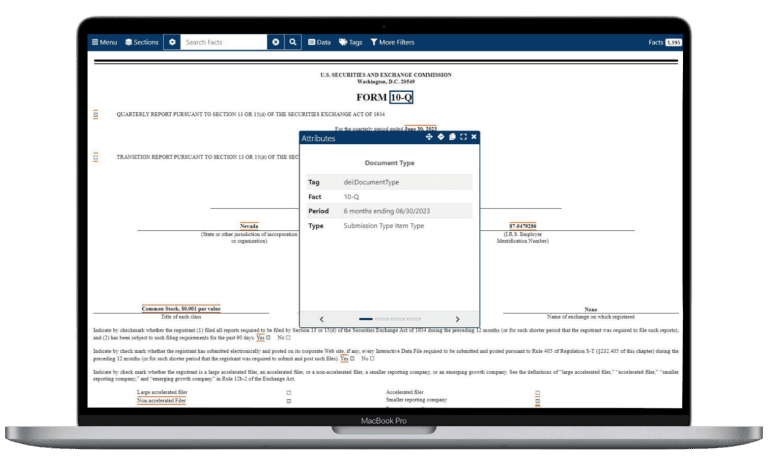
iXBRL documents are readable and understandable by both humans and machines. This makes it easier for companies to tag data in their financial reports. It makes them searchable and allows investors to easily compare financial information across companies and industries.
By integrating the XBRL data directly into the document, iXBRL offers increased efficiency and accuracy in preparing, analyzing, and communicating financial information.
Make Your Next SEC Filing the Easiest One Yet
Join hundreds of satisfied clients who trust our responsive team for their EDGAR/iXBRL filings, newswire, and financial printing needs.
What Forms Require iXBRL?
During the past few years, the list of forms that require iXBRL formatting has been growing. A few examples of forms that require Inline XBRL Filing include:
- Form 10-Q: This is a quarterly report that publicly traded companies are required to file with the SEC. It provides a comprehensive overview of a company’s performance, including both financial information and a discussion of the business from the management’s perspective.
- Form 10-K: This is an annual report required by the SEC. Similar to the 10-Q, it provides a comprehensive summary of a company’s performance, but is more detailed and includes audited financial statements.
- Form 20-F: Required to be filed by foreign companies that have securities trading in the U.S. It serves as an annual report for these companies, providing a comprehensive overview of the company’s financial performance.
- Form 40-F: Similar to 20-F, this form is required for certain Canadian companies that are registered with the SEC.
- Form 8-K: This form is used by companies to disclose material events that shareholders should know about, such as corporate changes or financial status updates.
- Form S-1: This is the initial registration form for new securities issued by public companies. It includes the business’s financial statements, information about the management team, and details of the planned use for the capital raised from the securities sale.
Keep in mind that the SEC is gradually expanding the forms that require iXBRL tagging, so check the SEC website for an updated list of forms that must be filed in this format.
iXBRL Reporting Requirements
For companies listed on stock exchanges in the United States, the Securities and Exchange Commission (SEC) has set specific iXBRL reporting requirements. These include:
- Submission of Interactive Data Files: As per SEC rules, U.S. public companies must submit their financial statements in iXBRL format along with their official filings.
- Use of US GAAP or IFRS Taxonomies: Companies must tag their financial statements using the U.S. Generally Accepted Accounting Principles (US GAAP) or International Financial Reporting Standards (IFRS) taxonomy.
- Detailed Tagging: Both the face financials and footnotes must be detailed-tagged. The face financials include the basic financial statements, while the footnotes include additional explanatory text and data.
- Accuracy and Consistency: Companies are responsible for the accuracy and consistency of their iXBRL submissions. This includes ensuring that the iXBRL data accurately reflects the official filing and that the appropriate tags have been used for each data element.
- Rendering Document: Companies must also provide a rendering of their XBRL data that shows the information in a human-readable format.
- Filing with EDGAR: All required iXBRL files must be submitted to the SEC’s EDGAR system, which is the Electronic Data Gathering, Analysis, and Retrieval system.
With so many requirements to keep in mind, it is helpful to rely on an expert team when it comes to inline XBRL. That is where we can help you.
Get Started with Inline XBRL Filing Requirements
iXBRL is a transformative tool in business and financial reporting. It provides several advantages, including cost savings, increased efficiency, improved data accuracy, and the potential for enhanced financial analysis. However, its adoption comes with specific requirements and challenges that require expertise and in-depth knowledge.
Colonial Filings is here to assist with all your iXBRL reporting requirements. Our team of experts will guide you through the iXBRL adoption process, ensure compliance with reporting requirements, and help leverage the advantages of iXBRL for your business. Our goal is to make sure that you comply with all SEC (Securities and Exchange Commission) requirements in a timely manner, streamlining your business.